BasinForge
Lumped hydrological simulation, calibration and sensitivity analysis for single and multiple catchments.


Documentation · Quick start · Case study · Release 0.1.0
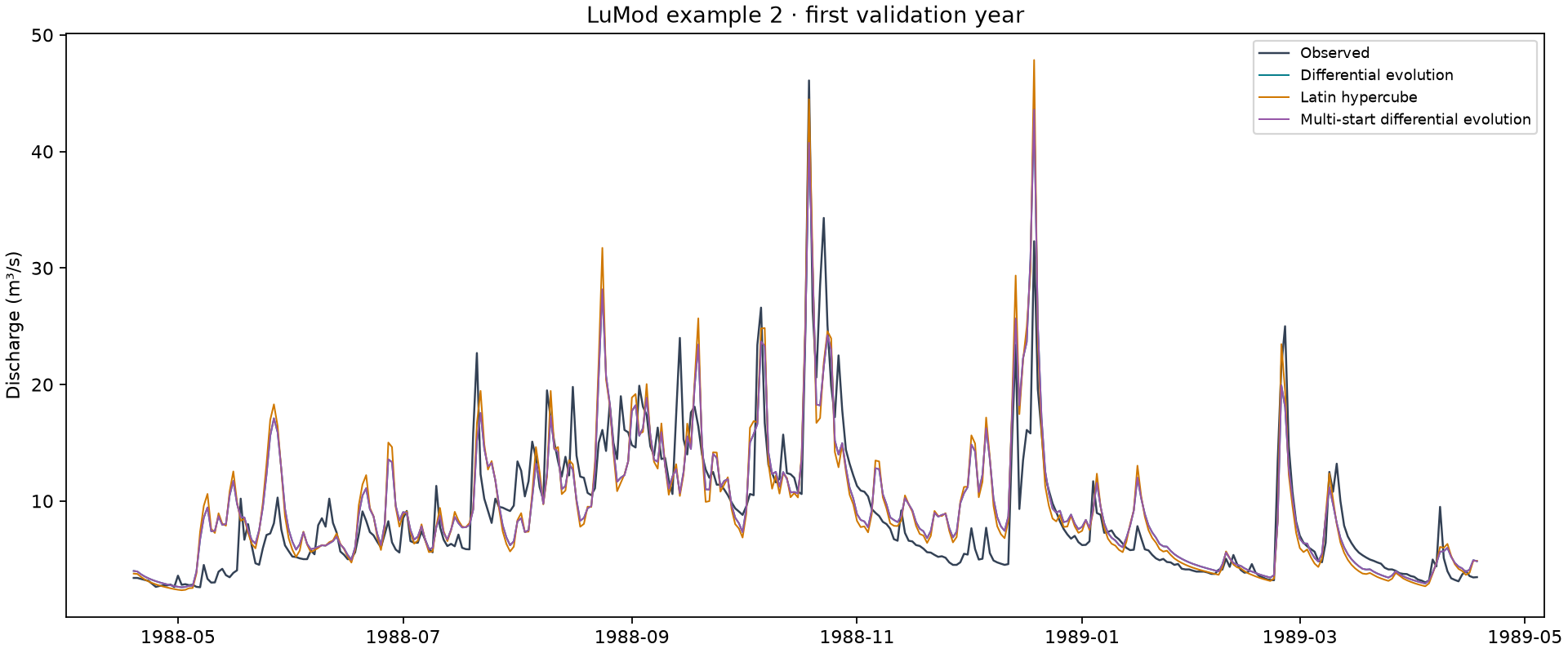
First validation year for LuMod example 2: observed flow and fits from differential evolution, Latin-hypercube search and multi-start calibration. Explore the case study.
Features
14 Python model implementations and 47 optional MARRMoT structures.
Single-basin, parallel multi-basin and shared-parameter calibration.
Differential evolution, Latin-hypercube search and multi-start fitting.
Chronological calibration and validation with NSE, KGE, RMSE and log NSE.
Morris and Sobol sensitivity analysis.
Saved parameters, simulations, hydrographs and HTML reports.
Time step |
Python models |
|---|---|
Daily |
GR3J, GR4J, GR5J, GR6J, HYMOD, HYMOD_CLASSIC, HBV, MILC, XAJ, XAJ_MZ, SMART |
Monthly |
GR2M, ABCD |
Annual |
GR1A |
The 47 optional daily MARRMoT structures require Octave and its optim package. See the model reference for equations, parameters and implementation details.
Install
Requires Python 3.11 or later. Install the 0.1.0 release with pip:
python -m pip install basinforge-hydro==0.1.0
basinforge doctor
For an editable installation:
git clone https://github.com/Barbhuiya12/basinforge-hydro.git
cd basinforge-hydro
python -m pip install -e .
Try the example data
From the checkout above, run the three-catchment LuMod case study:
python -m pip install -e '.[reference]'
python examples/lumod_case_study.py --output lumod-case-study
This creates fitted parameters, simulations, hydrographs, sensitivity plots and reports for every supported calibration search. Choose a new output directory.
Quick start
Calibrate GR4J, analyze parameter sensitivity and export a hydrograph report in one call:
from basinforge import Basin, CalibrationConfig, run_experiment

basin = Basin.from_csv(
    "basin.csv",
    basin_id="A",
    area_km2=1200,
    q_unit="m3/s",
    timestep="daily",
)

study = run_experiment(
    basin,
    "GR4J",
    CalibrationConfig(warmup=365, calibration_fraction=0.7, seed=42),
    sensitivity="morris",
    output="study-A",
)

print(study["fit"].parameters)
print(study["fit"].validation_metrics)
Your results are saved together:
study-A/
├── fit/
│   ├── fit.json
│   └── simulation.csv
├── report/
│   ├── index.html
│   ├── diagnostics.png
│   └── summary.json
└── sensitivity.json
Open study-A/report/index.html to inspect the hydrograph, flow-duration curve and calibration/validation scores.
Supply your own CSV and catchment area. Use date, precipitation, pet, qobs columns; temperature-dependent models also need temperature. Precipitation and PET are mm per model step. Set the observed discharge unit explicitly and choose a warmup appropriate to the model’s time step. Output directories must be new.
The same workflow is available from the command line:
basinforge experiment basin.csv --area 1200 --q-unit m3/s \
  --model GR4J --warmup 365 --calibration-fraction 0.7 \
  --sensitivity morris --output study-A
See the input guide, calibration guide and multi-basin guide for other workflows.
LuMod case study
The case study compares all supported calibration searches on three LuMod example catchments. It includes calibration and validation scores, observed and simulated hydrographs, Morris/Sobol sensitivity plots, and downloadable parameters and simulations.
License and credits
BasinForge is distributed under GPL-3.0-only. It incorporates scientific implementations from LuMod, hydromodel, SMARTpy and MARRMoT with retained licenses and attribution. See third-party credits for sources and model citations.